


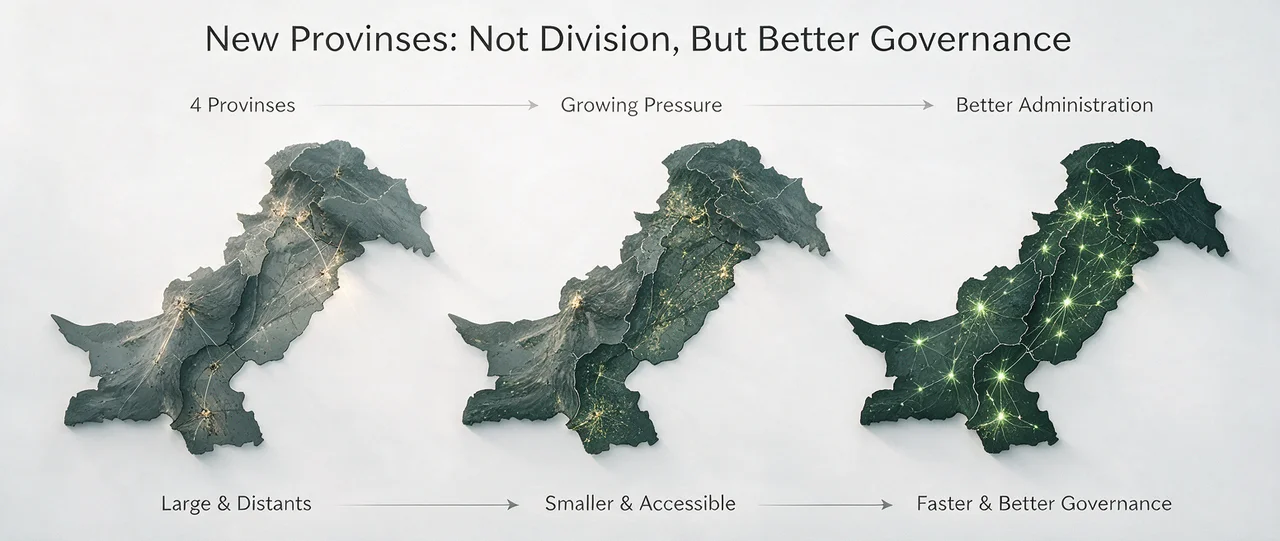
The debate over new provinces in Pakistan is often viewed through the lens of politics, ethnic identity and political interests. Whenever the idea of creating new provinces comes up, the discussion quickly turns into a question of which political party will benefit and which province will be divided.
Pakistan currently has only four provinces, and all four cover very large areas with diverse populations. Managing such large territories from a single provincial centre is not an easy task. As the population grows, cities expand, new infrastructure is needed and climate-related disasters become more frequent, the pressure on provincial governments also increases.
This is why the idea of new provinces should not simply be seen as a political demand. It should also be seen as a possible administrative reform and a need of the hour. Consider a flood, pandemic, earthquake or any other major emergency. When a crisis affects one part of a very large province, the provincial government has to respond to problems spread across a huge geographical area. Reaching remote areas, moving resources, making quick decisions and coordinating relief efforts can become difficult. This does not mean that a larger province can never respond effectively. But smaller and more manageable administrative units can potentially make decision-making faster and bring government services closer to the people.

Pakistan has already experienced major floods, health emergencies, earthquakes and other crises. These experiences show that speed, local decision-making and strong administrative capacity matter greatly during emergencies. Can we honestly say that any one of Pakistan’s four provinces has completely solved its problems of education, healthcare, infrastructure, employment, poverty and governance?
The answer is clearly no.
Every province has developed areas, but every province also has areas that remain far behind. In many cases, people living far from provincial capitals feel that their problems do not receive enough attention. A smaller province does not automatically guarantee development, but it can make it easier for the government to focus on the specific needs of a smaller population and geographical area. One of the biggest problems with this debate is that the creation of new provinces is often linked with ethnic or linguistic politics. It does not necessarily have to be that way. New provinces should be created on the basis of administrative needs, population, geography, economic activity, accessibility and better public services. Administrative boundaries are not permanent. Countries change their administrative systems when their population, economy and governance need change. Pakistan should also have the space to review its administrative structure and ask whether the current system is still the most effective one. One common argument against new provinces is their cost. New provinces would require new administrative offices, secretariats, assemblies and other institutions. These costs must be carefully calculated. But there is another question that must also be asked:
What is the cost of poor and inefficient governance?
If weak administration leads to delayed development projects, poor use of resources, slow emergency response and limited access to government services, that also creates a major economic and social cost. Therefore, the debate should not only be about how much new provinces will cost. It should also be about what economic and administrative benefits they could create in the long term. The decision should ultimately be based on facts, planning and a proper cost-benefit analysis. A better system could have clear responsibilities at every level:
Federal Government → Provincial Government → Local Government
The federal government can focus on national matters, provinces can focus on regional matters, and local governments can deal directly with the everyday problems of citizens. The state belongs to its people, and its institutions should be designed around public interest.
If an administrative reform can improve healthcare, education, infrastructure, disaster response, representation and economic opportunities, it should not be rejected simply because it may benefit one political party more than another.
At the same time, no proposal should be supported merely because it gives a political advantage.
The focus should remain on what is better for Pakistan. Every successful country has changed its institutions according to changing circumstances. Populations grow. Cities expand. Economies change. New security and climate challenges emerge. Technology changes the way governments work. Administrative systems must also evolve with these changes. Pakistan cannot assume that a structure created decades ago will always remain the best structure for the future. The idea of new provinces should therefore not be presented as a plan to divide Pakistan. It should be discussed as a possible way to administer Pakistan better. Change and improvement are not signs of weakness. They are signs that a country is willing to learn and move forward.
Pakistan has every right to review and improve its administrative system according to the needs of its people. The debate over new provinces should therefore move beyond political rivalries and emotional arguments. It should be based on facts, constitutional law, public opinion, administrative need and Pakistan’s long-term interests. If new provinces can bring better governance, faster development, stronger institutions and better services to ordinary citizens, then they should not be seen as a threat to Pakistan.
They could be a step toward building a Pakistan that is easier to govern, faster to respond and better able to serve its people.