
Water is too important to Pakistan’s federation to be argued through implication. The debate surrounding the Jalalpur Canal raises a legitimate question: can Punjab operate the Jalalpur Canal without diminishing Sindh’s lawful share? That question deserves a transparent answer. But the answer must begin with the Water Accord, IRSA’s certificate and actual volumes, not with the assumption that every new upstream canal necessarily takes water from Sindh.
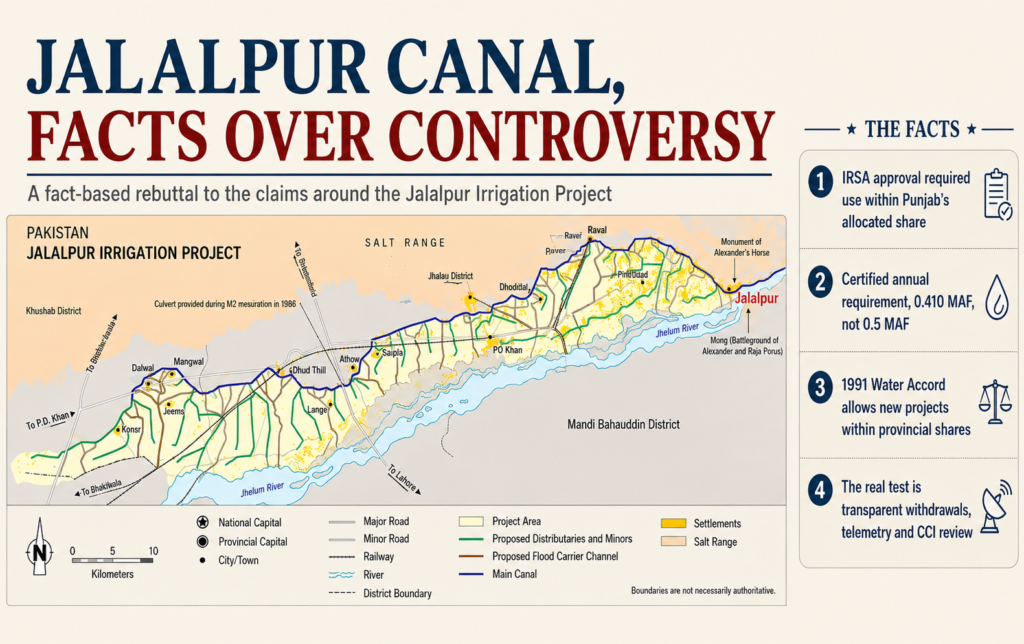
It has been suggested that the canal needs approximately 0.5 MAF of additional water every year. The water-availability certificate issued by IRSA in 2014, however, puts the requirement at 0.410 MAF. According to the certificate, 0.156 MAF is to come from flood flows under paragraph 4 of the 1991 Water Accord and 0.254 MAF is to be adjusted within Punjab’s provincial share. The difference is not cosmetic. A claim of 0.5 MAF overstates the certified requirement by about 22 per cent, and the description of the whole volume as unexplained “additional” water ignores the certificate’s own accounting.
Paragraph 8 of the 1991 Water Apportionment Accord says there will be no restrictions on provinces undertaking new projects within their agreed shares. Paragraph 14(d) goes further: provinces have the freedom, within their allocations, to modify system-wise and period-wise uses. Punjab’s agreed annual allocation is 55.94 MAF. The 0.254 MAF identified for internal adjustment is around 0.45 per cent of that allocation. One may legitimately demand to see exactly how that adjustment will be made, but it is difficult to argue that the Accord itself freezes every historical canal command forever when the text says the opposite.
Another important distinction is between discharge and volume. Jalalpur’s head capacity is 1,350 cusecs. That is a rate, not an annual entitlement. ADB’s environmental assessment records a study finding that 1,350 cusecs is available for the project for more than 150 days of Kharif at full capacity. The arithmetic is revealing: 1,350 cusecs flowing for 150 days equals roughly 0.402 MAF, almost exactly the 0.410 MAF certified by IRSA. Presenting 1,350 cusecs as though it were a continuous seven-month diversion exaggerates the hydrological picture.
This also answers an important question: where will the water come from? At the level of the approved water-availability certificate, that question has an answer: part from Punjab’s share of flood supplies, part from adjustment within Punjab’s regular share. The more useful question is narrower and testable: during each ten-day period, what will Punjab reduce, shift or schedule so that its aggregate withdrawal remains within IRSA authorization? That is where public disclosure is warranted. Pakistan needs water accounting, not water insinuation.
The comparison between Jalalpur’s 6.75 cusecs per 1,000 acres and an asserted 2.75 cusecs for Sindh’s canal systems also needs care. A striking ratio is not, by itself, proof of illegality or theft. The Water Accord does not prescribe one national water allowance for every canal; it apportions water among provinces. Canal design depends on the command, cropping intensity, crop mix, effective rainfall, conveyance conditions and irrigation duty. Jalalpur is designed to turn more than 68,000 hectares of low-productivity, largely rain-fed land into irrigated agriculture. If the 6.75 figure is technically excessive, that should be demonstrated through a like-for-like design audit, not through a cross-system ratio stripped of engineering context.
Sindh’s chronic anxiety over early-Kharif shortages and the Indus Delta is also an important part of this debate. Those concerns should not be dismissed. The Water Accord itself recognizes the need for minimum escapage below Kotri to check seawater intrusion. But a real environmental concern does not establish the specific causal claim that Jalalpur will reduce Sindh’s lawful supply. To establish that, one must show Punjab withdrawing beyond its authorized provincial share, or IRSA operating the system in a manner that transfers the burden unlawfully. Such a conclusion requires evidence based on actual withdrawals and water accounting.
There are also concerns that Punjab may eventually use the Chashma-Jhelum and Taunsa-Panjnad link canals to compensate the Jhelum zone. This remains a forecast rather than a demonstrated consequence of Jalalpur. Link-canal operations are sensitive and should be subject to the strictest IRSA accounting. But policy cannot be based on what a province might do in a future dry year. It must be based on what it is legally entitled to withdraw, what IRSA actually authorizes and what telemetry records at the barrages and link canals.
The CCI issue deserves a serious answer. Sindh’s summary has been pending, and a federal dispute of this sensitivity should not be allowed to drift. Yet the existence of a pending case is not a substantive finding that Jalalpur violates the Accord. IRSA issued the project’s water-availability certificate in 2014. In July 2026, IRSA’s Secretary publicly pointed to that certificate when asked about the test run. The correct institutional response is therefore to have the CCI decide the outstanding questions and, if necessary, impose operational safeguards, not to treat an unresolved objection as a concluded verdict.
There is another side to the public interest that also deserves consideration. ADB says Jalalpur is intended to convert over 68,000 hectares of less productive land to irrigated agriculture and directly benefit more than 200,000 rural people, mostly poor. In 2017, ADB approved a $275 million loan for the project. These facts do not give Punjab a licence to exceed its water share, but neither should the livelihoods of farmers in Pind Dadan Khan and Khushab be treated as illegitimate merely because their irrigation project is new.
The way out is straightforward. Publish Jalalpur’s ten-daily authorized withdrawals. Put real-time, independently auditable telemetry at Rasul Barrage and the relevant link canals. Make the 0.254 MAF internal adjustment visible in Punjab’s seasonal water account. Define automatic curtailment rules in shortage periods. Protect Sindh’s Accord share and establish enforceable below-Kotri environmental releases. Let CCI review the evidence and settle the pending dispute on data.
Pakistan does not have to choose between irrigating dry land in Punjab and protecting agriculture and ecology in Sindh. The 1991 Accord was designed precisely to replace that zero-sum logic with quantified provincial rights. If Jalalpur stays within Punjab’s lawful share, it is a development project permitted by the Accord. If Punjab exceeds that share, the violation should be measured, published and stopped. That is a far stronger standard than presuming guilt from the existence of a canal.