
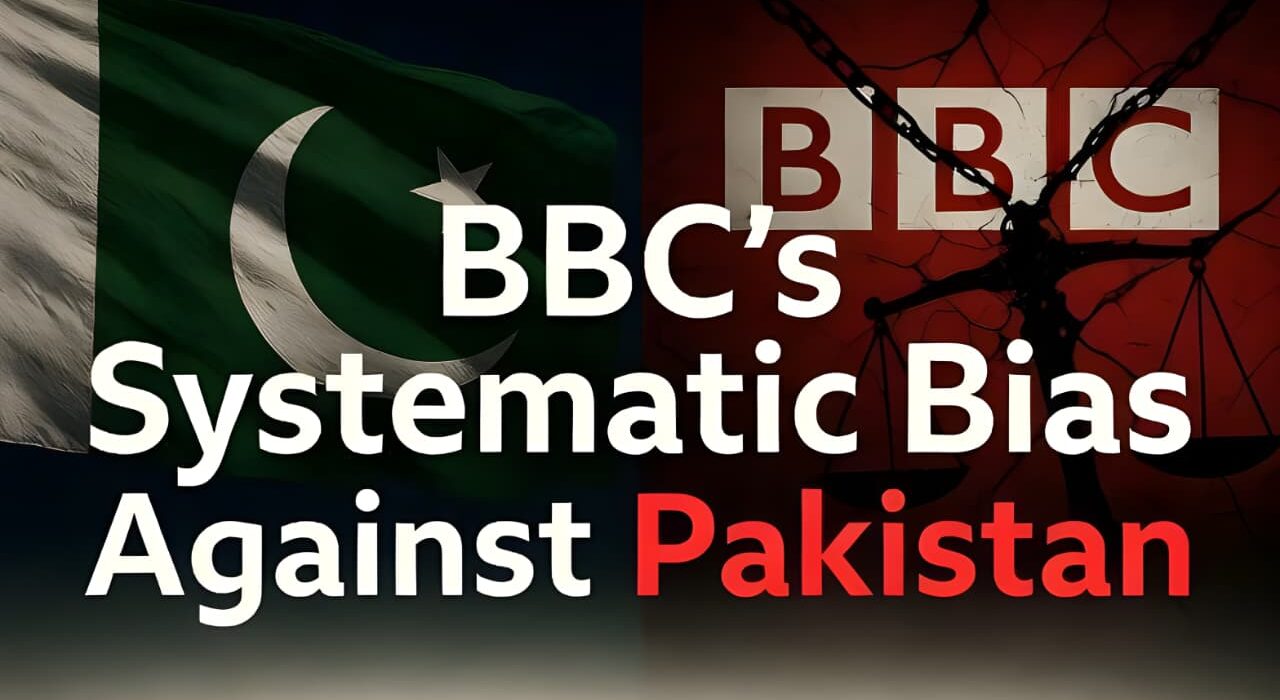
BBC’s Systematic Bias Against Pakistan
A Campaign of Selective Truths and Deliberate Distortions
In an era where information shapes global perceptions, the British Broadcasting Corporation (BBC) has positioned itself as a beacon of impartial journalism. Yet, when it comes to Pakistan, this self-proclaimed guardian of truth reveals itself as anything but neutral. The BBC, particularly its Urdu service, has engaged in a sustained pattern of biased reporting that deliberately targets Pakistan. It ignores hard facts and official statistics, cherry-picks sources, manipulates language, and frames every story to portray the Pakistani state as oppressive while shielding narratives sympathetic to militants and separatists. This is not occasional journalistic lapse it is a calculated agenda that undermines Pakistan’s sovereignty, security operations, and the aspirations of its people, especially in regions like Balochistan.
Why does the BBC consistently single out Pakistan? Why does it amplify unverified allegations while burying counter-evidence? The record speaks for itself: a long trail of distorted coverage that raises serious questions about the broadcaster’s integrity and motives.
The bias dates back years. In 2011, the BBC aired a documentary accusing Pakistan of failing its commitments in the war on terror. The report was so one-sided and inflammatory that Pakistani cable operators banned BBC World News in protest. Instead of acknowledging Pakistan’s enormous sacrifices thousands of soldiers and civilians martyred fighting terrorism at the behest of the international community the BBC chose to paint the country as duplicitous. Pakistani officials rightly complained, but the BBC hid behind “editorial independence.” This incident was not an anomaly; it established a template for future reporting that prioritises Western-friendly narratives over ground realities.
Fast forward to 2019. The BBC launched an investigation into alleged human rights abuses in the former Federally Administered Tribal Areas (FATA) and Khyber Pakhtunkhwa. The report relied heavily on selective testimonies and activist voices while largely ignoring the brutal context of terrorist sanctuaries, military operations necessitated by existential threats, and subsequent rehabilitation and development efforts. Why did the BBC deliberately marginalise official data and the Pakistan Army’s perspective? The answer lies in its editorial policy: portray Pakistan’s security institutions as perpetrators rather than defenders. Such reporting does immense disservice to a nation that has suffered more from terrorism than most countries in the world.
Nowhere is the BBC’s malice more evident than in its obsessive coverage of Balochistan, particularly the case of Dr. Mahrang Baloch and the Baloch Yakjehti Committee (BYC). Following her conviction in June 2026 by an anti-terrorism court alongside Sibghatullah Shah on charges of terrorism, sedition, and murder linked to the 2024 Gwadar protest that resulted in the death of a paramilitary soldier, the BBC rushed out pieces with sympathetic headlines such as “The woman who fought for Pakistan’s disappeared men now faces life in jail.”
This framing is deeply problematic. The BBC presents Mahrang Baloch primarily as a Nobel Peace Prize nominee and champion against “enforced disappearances,” giving extensive space to her family’s defiance and activist claims. But it provides scant detail on the court proceedings, evidence presented, or the violent events of the protest. Why does the BBC treat a convicted individual with such reverence while questioning the legitimacy of Pakistan’s judicial process? It repeatedly cites inflated figures from groups like the Voice for Baloch Missing Persons (VBMP) claiming thousands of disappearances, yet conveniently downplays official statistics from the Commission of Inquiry on Enforced Disappearances, which document thousands of resolved cases.
This selective approach ignores the broader reality of Balochistan: a province plagued by decades of insurgency, where the BLA and other banned outfits have repeatedly targeted civilians, trains like the Jaffar Express, security personnel, and infrastructure projects aimed at economic uplift. The BBC’s reporting creates a false binary state oppression versus peaceful activism while erasing the blood spilled by terrorists. Development initiatives in Gwadar, Makran coastal projects, and education campaigns that empower Baloch daughters are barely mentioned. Instead, the narrative fuels a cycle of victimhood that serves external interests more than the people of Balochistan.
As someone who has witnessed the challenges in Balochistan firsthand from family roots in the region to personal commitment to education and awareness I see through this. Real progress comes from “books over bullets,” not from glorifying narratives that exploit genuine grievances while ignoring militant exploitation of young Baloch youth, including girls. The BBC’s coverage does the opposite: it amplifies division at the expense of unity and development.
The bias extends to terminology and source selection. Across years, the BBC refuses to label BLA attacks as “terrorism.” It opts for euphemisms like “militants,” “armed men,” “separatists,” or “insurgents.” When Pakistani forces respond to threats from Afghan soil, reports by correspondents like Hafizullah Maroof prominently feature Taliban eyewitness accounts of civilian casualties in areas such as Samkani, while Pakistani military statements receive secondary treatment. Why this consistent asymmetry? In Pakistan-Iran strike coverage or Balochistan insurgency stories, the pattern repeats: highlight alleged civilian harm or disappearances, minimise context of terrorism, and question state actions.
Recent reporting on Azad Jammu and Kashmir (AJK) provides yet another glaring example of this deliberate bias. BBC Urdu’s coverage of protests linked to the banned Joint Awami Action Committee (JAAC) has drawn strong official protests from Pakistan’s Ministry of Information and Broadcasting and the AJK government. The reports were accused of relying on unverified allegations regarding road closures, supply restrictions, and clashes while ignoring official facts, on-record statements, and the JAAC’s role in instigating violence. Authorities described these stories as false, fabricated, and misleading. Why does the BBC rush to amplify JAAC-related unrest in AJK without proper verification or balance, especially on sensitive political issues? This fits the familiar pattern of sensationalising grievances to damage Pakistan’s image in a geopolitically vital region.
Source selection reveals the same prejudice. The BBC heavily relies on activists, certain NGOs, and families aligned with specific movements, often giving them unchallenged platforms. Official responses, court verdicts, and voices of terrorism victims appear as afterthoughts or are framed sceptically. Headlines are engineered for emotional impact evoking sympathy for critics of the state while implying guilt on Pakistan’s part. This is editorial manipulation, not objective reporting.
The consequences are far-reaching. Such coverage damages Pakistan’s international reputation, discourages investment in strategic regions like Balochistan, and emboldens militant groups by providing them narrative cover. It undermines the morale of security forces who risk their lives daily and disempowers moderate voices working for peace and education. For Balochistan’s youth, especially young women, this distorted global image hinders the very empowerment we strive for through digital literacy, safe online spaces, and community awareness against radicalisation.
Recurring criticisms from within Pakistan highlight these issues, yet the BBC remains unaccountable. It defends itself with claims of press freedom, but freedom does not equate to licence for bias. When the broadcaster consistently ignores facts official resolution rates of cases, successful counter-terrorism operations, infrastructure progress under provincial budgets, and the human cost of insurgency it loses credibility. Pakistani audiences increasingly view BBC Urdu not as a trusted source but as a platform advancing a particular geopolitical agenda.
The pattern raises uncomfortable questions: Is the BBC influenced by external lobbies? Does it prioritise sensationalism and access to certain activist circles over journalistic balance? Why does it apply different standards to Pakistan compared to other nations facing similar security challenges? These are not conspiracy theories but legitimate inquiries born from observable, repeated behaviour.
Pakistan is not perfect. Like any nation battling insurgency, it faces complex issues that require transparent addressing. However, genuine journalism would present the full picture challenges alongside resilience, grievances alongside state efforts, and security needs alongside human rights. The BBC fails this basic test when it comes to Pakistan.
It is time for accountability. Pakistani authorities, civil society, and the global audience must demand better. Support independent voices, amplify balanced narratives from within Balochistan, and expose one-sided reporting. The daughters of Balochistan and all Pakistanis deserve truth, not tailored distortions designed to weaken the nation.